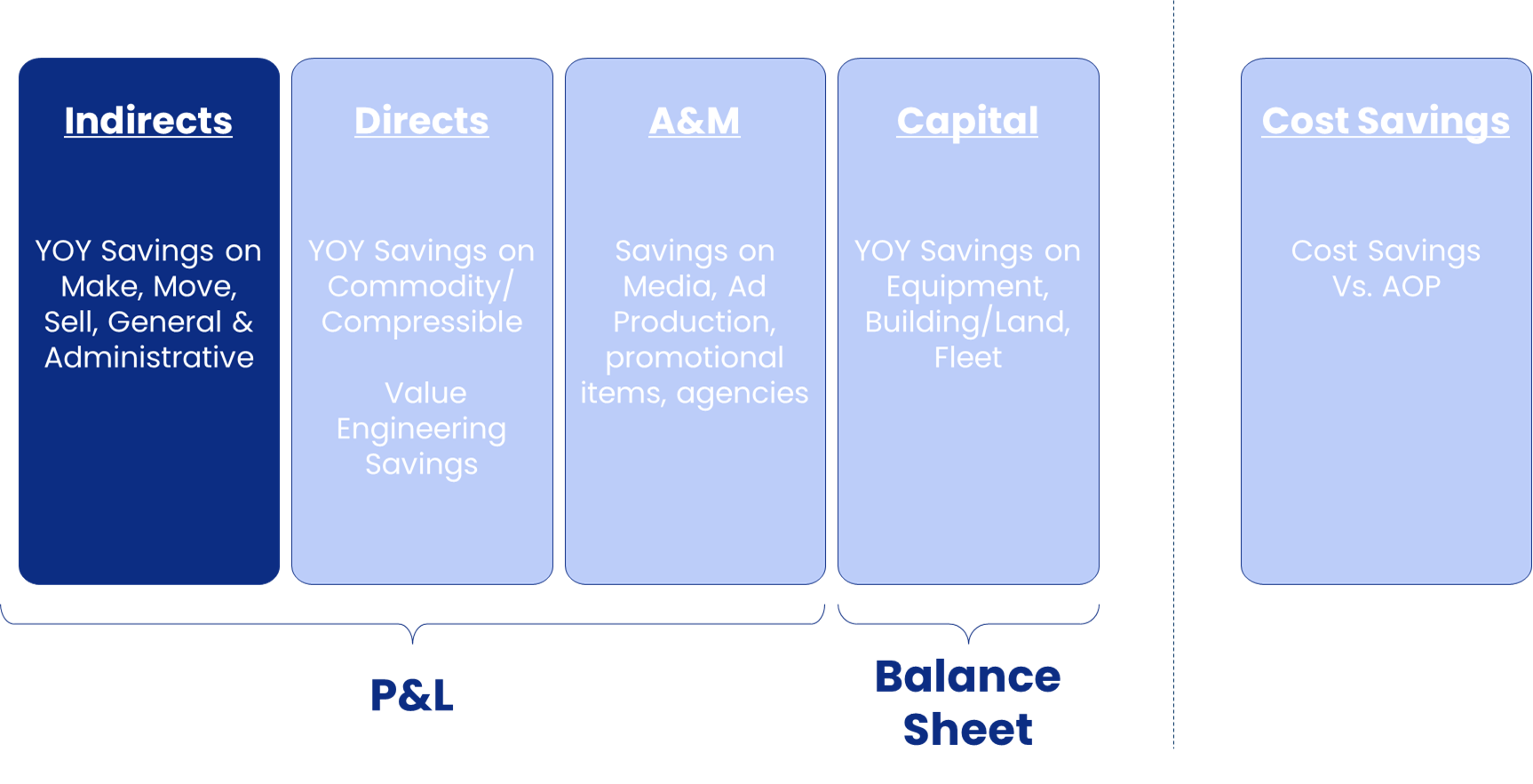
Global Procurement Areas of Reportable Productivity
Indirects Productivity Definition
Indirects Productivity refers to savings related to the costs in the Make/Move/Sell/G&A accounts. It is also referred to as "Operations Productivity" and impacts various operating expenses YoY savings amount and as a percentage of managed indirects spend.
Productivity = (YoY Change in Cost Per Unit) x (Number of Units Purchased in the Current Year)
Productivity Savings KPI is calculated as: Productivity Savings / "Managed Indirect Spend" - Current Year Productivity Savings
Prior Year Calculated Indirects Managed Spend = Current Year Managed Indirects Spend + Current Year Productivity Savings
-> Managed Indirects Spend is the segment of total indirects spend that has Global Procurement resources assigned against it.
Common Examples
- Make: Reducing the cost of cleaning & sanitation services in the plant
- Move: Optimizing outbound freight of finished goods to reduce overall cost
- Sell: Enhancing sales efficiency and profitability through optimizing rates on purchased goods and services
- G&A: Negotiating lower rental costs for offices
Key Productivity Drives
- Re-negotiating existing contracts using best practices to drive value; YoY productivity based on tangible cost reductions over comparable PY baseline (e.g., rate reductions)
- Consolidating spend across markets and regions centrally to gain leverage and drive savings
Total Cost of Ownership

Analyzing TCO
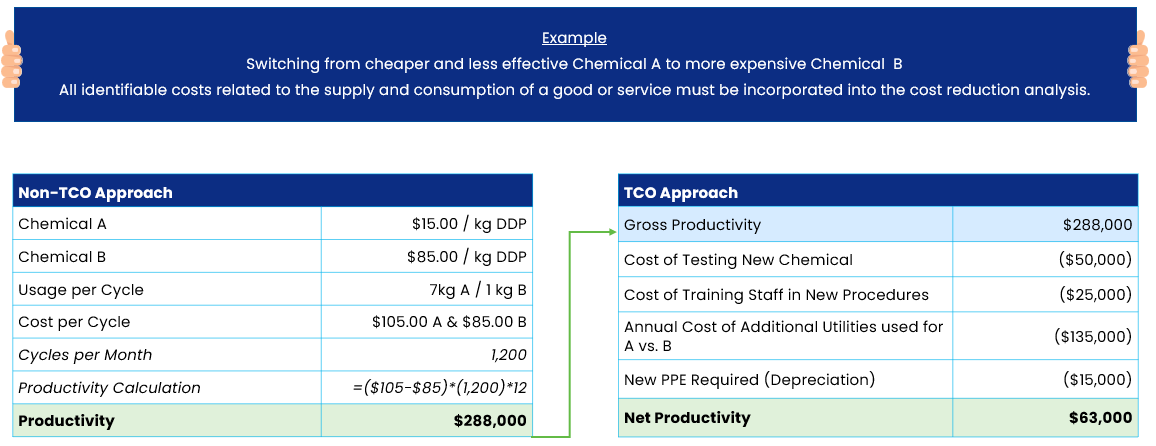
- TCO is an analysis meant to uncover all the costs of acquiring a good or service that allows to look beyond the price to include many other purchase related costs
- Calculating beyond the initial price, TCO helps make strategic decisions, avoid hidden expense, and identify the most cost-effective impact on P&L benefit
Asset Ownership
- Asset ownership entails cost of the actual purchase, but it also involves costs due to installing, deploying, using, upgrading, and maintaining the same assets; these post-purchase costs can be substantial
- For many kinds of assets, TCO analysis finds a very large difference between the purchase price and the total life cycle costs
- The difference between purchase price and total life cycle costs can be especially large when ownership covers a long time period